
-
Why Should We Worship Maa Gayatri?
In temples, homes and hearts across India, Maa Gayatri is remembered with a special kind of love. She is not worshipped only for a particular wish or on a particular festival; she is turned to every single morning, in the quiet moments before the day begins, as the mother who gives light to the mind. Many people know her name through the Gayatri Mantra, yet fewer pause to ask: who is Maa Gayatri, and why have saints, scholars and ordinary families alike held her worship so dear for thousands of years? This article explores that question – not as a matter of ritual alone, but as a path that can bring real clarity, strength and goodness into our lives.
Who is Maa Gayatri?
Maa Gayatri is the divine mother of wisdom, the living form of the Gayatri Mantra. The mantra, found in the Rig Veda and revealed through Rishi Vishvamitra, is a prayer to the radiant divine light to awaken our intellect. Over time, the power within that prayer came to be worshipped as a goddess – a compassionate mother who answers the most important prayer a human being can make: "Lead my mind towards the light."
She is lovingly called Vedamata, the mother of the Vedas, because the essence of all Vedic knowledge is said to be contained in her mantra. In the Gayatri Pariwar tradition established by Pandit Shriram Sharma Acharya, she is also remembered as Devamata, the mother of divine qualities, and Vishvamata, the mother of the whole world. These three names describe three gifts: true knowledge, a noble character and a heart that embraces all of creation.
The importance of Gayatri is affirmed again and again in our scriptures. In the Bhagavad Gita, Lord Krishna, describing his own divine glories, says that among poetic metres he is the Gayatri. Countless sages have said that just as honey is the essence of flowers, Gayatri is the essence of the Vedas.
What her form teaches us
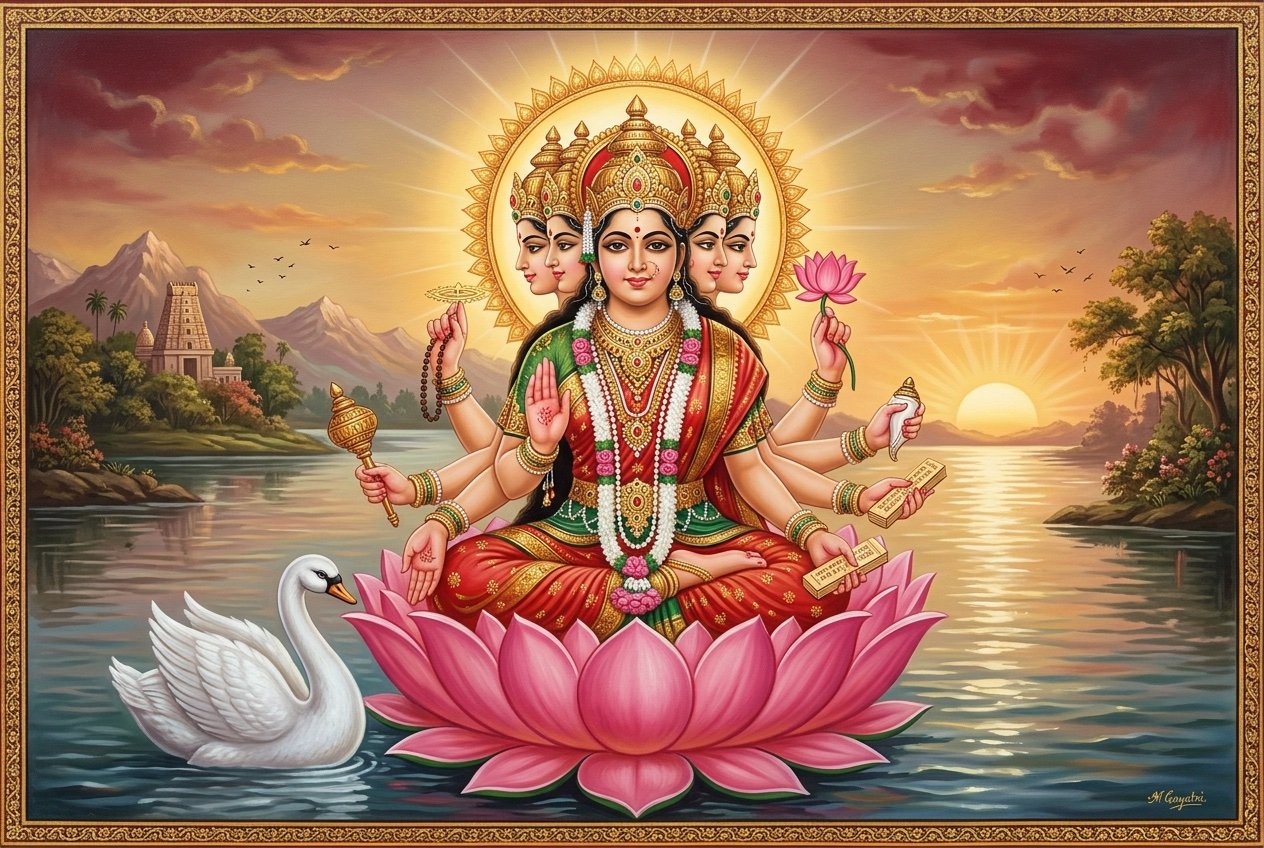
Images of Maa Gayatri are rich with symbolism, and each element carries a lesson for our own lives.
She is often shown with five faces, representing the five elements – earth, water, fire, air and space – from which the whole universe and our own bodies are made. They also remind us of the five senses and the five layers of our being, from the physical body to the blissful self. Her five faces tell us that the divine is present in every part of creation and every part of ourselves.
She is seated on a lotus, the flower that grows in muddy water yet remains spotless and beautiful. The lotus teaches us that we too can live in the middle of the world's difficulties without being stained by them – working, caring for our families and meeting challenges, while keeping the mind pure.
Beside her is the swan (hamsa), which in Indian tradition is said to be able to separate milk from water. It is the symbol of viveka, the power of discernment – the ability to tell right from wrong, truth from falsehood, and what is lasting from what is fleeting. This is precisely the gift the Gayatri Mantra asks for: a pure and discerning intellect.
In her hands she holds objects such as the Vedas, symbolising knowledge; the mala, symbolising devotion and steady practice; and the lotus, symbolising purity. Some images show her offering abhaya and varada mudras – the gestures of fearlessness and blessing – reminding devotees that the mother protects and gives generously to those who come to her with sincerity.
Her radiance, like the rising sun, is perhaps the most important symbol of all. Just as the morning sun drives away the darkness of night without any effort, the light of Gayatri dispels the darkness of ignorance, fear and confusion from the mind.
Why we worship Maa Gayatri
She gives the greatest gift: a good intellect
Every action we take begins with a thought, and every thought is shaped by the quality of our intellect. When the mind is clouded by anger, greed, fear or confusion, even good intentions lead to poor choices. When the mind is clear and pure, wise action follows naturally. The tradition teaches that worshipping Maa Gayatri purifies and illuminates this intellect, which the scriptures call sadbuddhi. Rather than asking for any single blessing, we ask for the one thing that makes every other good thing possible.
She is the mother of all, without distinction
Maa Gayatri is the mother of the whole world, and a mother does not divide her children by caste, gender, wealth or background. For a long time, access to the Gayatri Mantra was restricted, but the great reformers of the last century, especially Pandit Shriram Sharma Acharya and Mata Bhagwati Devi Sharma, worked tirelessly to bring her worship to every home. Their message was clear: anyone who approaches the mother with sincerity is welcome. This openness is one of the most beautiful aspects of Gayatri worship, and it is the spirit in which Maa Bageshwari Gayatri Dham welcomes all.
Her worship builds character, not only devotion
Worship of Maa Gayatri is not meant to stay within the walls of a temple or puja room. True Gayatri upasana shows itself in the way we live: in honesty at work, patience at home, self-discipline in our habits and kindness towards others. The tradition teaches that the mother is most pleased not with elaborate offerings, but with a life that grows steadily more truthful, pure and generous. In this way, her worship becomes a daily school of character.
She brings peace and steadiness to the mind
Modern life pulls the mind in many directions at once. Regular prayer to Maa Gayatri, especially the slow chanting of her mantra in the early morning, gives the mind an anchor. Devotees often describe a growing sense of calm, an ability to face difficulties without panic, and a quiet inner confidence that they are not alone. These are spiritual experiences rather than guarantees, and they deepen with sincere and regular practice, but they have been shared by countless people across generations.
Her worship connects us to our roots
When we worship Maa Gayatri, we join an unbroken chain of prayer stretching back thousands of years – the same mantra chanted by the rishis, by our grandparents and by families across the world today. Passing this practice on to our children gives them a gift of lasting value: a simple, daily way to remain connected to wisdom, values and the divine, wherever life may take them.
She inspires service to society
In the Gayatri tradition, worship is incomplete without service. The light we receive in prayer is meant to be shared – through helping the needy, educating children, protecting the environment and strengthening the community. Gayatri yajnas themselves are performed for the welfare of all, not for personal gain. Worshipping Maa Gayatri therefore gently turns us from a life centred on ourselves to a life that contributes to others.
How to worship Maa Gayatri at home
Worship of Maa Gayatri does not require elaborate arrangements. What she values most is a sincere heart and regular remembrance.
Set aside a small, clean place in your home with a picture or idol of Maa Gayatri. Each morning, after bathing, light a diya and incense and offer a flower if you have one. Sit quietly, take a few deep breaths, and chant the Gayatri Mantra slowly – one mala of 108 repetitions if you can, or even eleven or twenty-one repetitions when time is short. While chanting, imagine the golden light of the mother filling your mind and heart.
End with a short prayer in your own words: for wisdom, for strength to do what is right, and for the well-being of your family and of all beings. Many families also perform a simple aarti in the evening and observe special worship on Gayatri Jayanti, which is celebrated with great devotion every year.
Above all, try to carry her worship into your day. Speak truthfully, work honestly, help someone in need and keep your thoughts pure. In the Gayatri tradition, this is regarded as the highest offering of all.
Worship at Maa Bageshwari Gayatri Dham
At Maa Bageshwari Gayatri Dham, devotees gather to worship Maa Gayatri through daily prayer, collective chanting, satsang and our monthly Gayatri Havan, where offerings are made into the sacred fire for the welfare of all. We also celebrate the major festivals of the year together and organise programmes for youth and families. Whether you come to pray, to learn, or simply to sit in a peaceful place, the doors of the Dham are always open to you.
May Maa Gayatri bless every home with wisdom, peace and goodness, and may her light guide all of us on the path of truth.
जय माँ गायत्री
 English