

Category: Insights

  • Why Should We Worship Maa Gayatri?

    Why Should We Worship Maa Gayatri?

    In temples, homes and hearts across India, Maa Gayatri is remembered with a special kind of love. She is not worshipped only for a particular wish or on a particular festival; she is turned to every single morning, in the quiet moments before the day begins, as the mother who gives light to the mind. Many people know her name through the Gayatri Mantra, yet fewer pause to ask: who is Maa Gayatri, and why have saints, scholars and ordinary families alike held her worship so dear for thousands of years? This article explores that question – not as a matter of ritual alone, but as a path that can bring real clarity, strength and goodness into our lives.

    Who is Maa Gayatri?

    Maa Gayatri is the divine mother of wisdom, the living form of the Gayatri Mantra. The mantra, found in the Rig Veda and revealed through Rishi Vishvamitra, is a prayer to the radiant divine light to awaken our intellect. Over time, the power within that prayer came to be worshipped as a goddess – a compassionate mother who answers the most important prayer a human being can make: "Lead my mind towards the light."

    She is lovingly called Vedamata, the mother of the Vedas, because the essence of all Vedic knowledge is said to be contained in her mantra. In the Gayatri Pariwar tradition established by Pandit Shriram Sharma Acharya, she is also remembered as Devamata, the mother of divine qualities, and Vishvamata, the mother of the whole world. These three names describe three gifts: true knowledge, a noble character and a heart that embraces all of creation.

    The importance of Gayatri is affirmed again and again in our scriptures. In the Bhagavad Gita, Lord Krishna, describing his own divine glories, says that among poetic metres he is the Gayatri. Countless sages have said that just as honey is the essence of flowers, Gayatri is the essence of the Vedas.

    What her form teaches us

    Images of Maa Gayatri are rich with symbolism, and each element carries a lesson for our own lives.

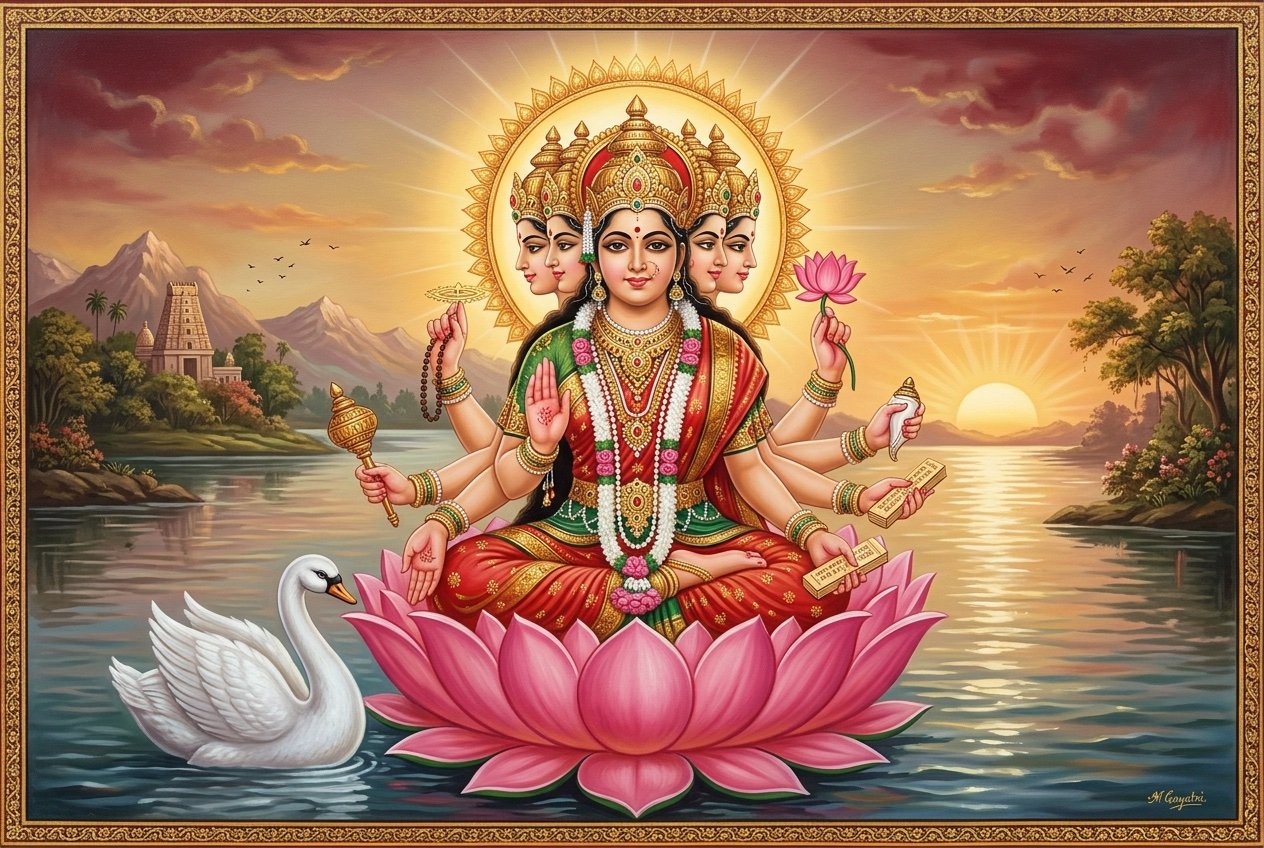
    She is often shown with five faces, representing the five elements – earth, water, fire, air and space – from which the whole universe and our own bodies are made. They also remind us of the five senses and the five layers of our being, from the physical body to the blissful self. Her five faces tell us that the divine is present in every part of creation and every part of ourselves.

    She is seated on a lotus, the flower that grows in muddy water yet remains spotless and beautiful. The lotus teaches us that we too can live in the middle of the world's difficulties without being stained by them – working, caring for our families and meeting challenges, while keeping the mind pure.

    Beside her is the swan (hamsa), which in Indian tradition is said to be able to separate milk from water. It is the symbol of viveka, the power of discernment – the ability to tell right from wrong, truth from falsehood, and what is lasting from what is fleeting. This is precisely the gift the Gayatri Mantra asks for: a pure and discerning intellect.

    In her hands she holds objects such as the Vedas, symbolising knowledge; the mala, symbolising devotion and steady practice; and the lotus, symbolising purity. Some images show her offering abhaya and varada mudras – the gestures of fearlessness and blessing – reminding devotees that the mother protects and gives generously to those who come to her with sincerity.

    Her radiance, like the rising sun, is perhaps the most important symbol of all. Just as the morning sun drives away the darkness of night without any effort, the light of Gayatri dispels the darkness of ignorance, fear and confusion from the mind.

    Why we worship Maa Gayatri

    She gives the greatest gift: a good intellect

    Every action we take begins with a thought, and every thought is shaped by the quality of our intellect. When the mind is clouded by anger, greed, fear or confusion, even good intentions lead to poor choices. When the mind is clear and pure, wise action follows naturally. The tradition teaches that worshipping Maa Gayatri purifies and illuminates this intellect, which the scriptures call sadbuddhi. Rather than asking for any single blessing, we ask for the one thing that makes every other good thing possible.

    She is the mother of all, without distinction

    Maa Gayatri is the mother of the whole world, and a mother does not divide her children by caste, gender, wealth or background. For a long time, access to the Gayatri Mantra was restricted, but the great reformers of the last century, especially Pandit Shriram Sharma Acharya and Mata Bhagwati Devi Sharma, worked tirelessly to bring her worship to every home. Their message was clear: anyone who approaches the mother with sincerity is welcome. This openness is one of the most beautiful aspects of Gayatri worship, and it is the spirit in which Maa Bageshwari Gayatri Dham welcomes all.

    Her worship builds character, not only devotion

    Worship of Maa Gayatri is not meant to stay within the walls of a temple or puja room. True Gayatri upasana shows itself in the way we live: in honesty at work, patience at home, self-discipline in our habits and kindness towards others. The tradition teaches that the mother is most pleased not with elaborate offerings, but with a life that grows steadily more truthful, pure and generous. In this way, her worship becomes a daily school of character.

    She brings peace and steadiness to the mind

    Modern life pulls the mind in many directions at once. Regular prayer to Maa Gayatri, especially the slow chanting of her mantra in the early morning, gives the mind an anchor. Devotees often describe a growing sense of calm, an ability to face difficulties without panic, and a quiet inner confidence that they are not alone. These are spiritual experiences rather than guarantees, and they deepen with sincere and regular practice, but they have been shared by countless people across generations.

    Her worship connects us to our roots

    When we worship Maa Gayatri, we join an unbroken chain of prayer stretching back thousands of years – the same mantra chanted by the rishis, by our grandparents and by families across the world today. Passing this practice on to our children gives them a gift of lasting value: a simple, daily way to remain connected to wisdom, values and the divine, wherever life may take them.

    She inspires service to society

    In the Gayatri tradition, worship is incomplete without service. The light we receive in prayer is meant to be shared – through helping the needy, educating children, protecting the environment and strengthening the community. Gayatri yajnas themselves are performed for the welfare of all, not for personal gain. Worshipping Maa Gayatri therefore gently turns us from a life centred on ourselves to a life that contributes to others.

    How to worship Maa Gayatri at home

    Worship of Maa Gayatri does not require elaborate arrangements. What she values most is a sincere heart and regular remembrance.

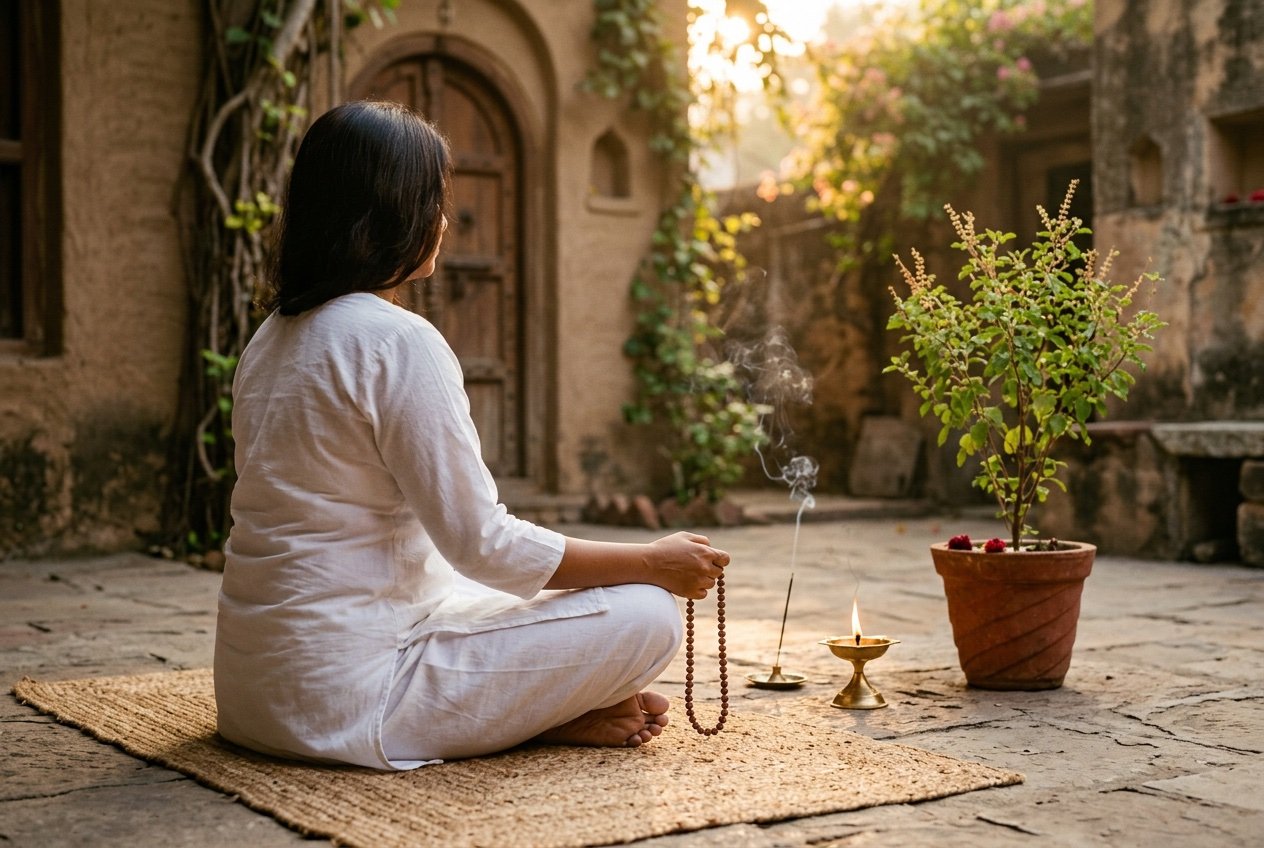
    Set aside a small, clean place in your home with a picture or idol of Maa Gayatri. Each morning, after bathing, light a diya and incense and offer a flower if you have one. Sit quietly, take a few deep breaths, and chant the Gayatri Mantra slowly – one mala of 108 repetitions if you can, or even eleven or twenty-one repetitions when time is short. While chanting, imagine the golden light of the mother filling your mind and heart.

    End with a short prayer in your own words: for wisdom, for strength to do what is right, and for the well-being of your family and of all beings. Many families also perform a simple aarti in the evening and observe special worship on Gayatri Jayanti, which is celebrated with great devotion every year.

    Above all, try to carry her worship into your day. Speak truthfully, work honestly, help someone in need and keep your thoughts pure. In the Gayatri tradition, this is regarded as the highest offering of all.

    Worship at Maa Bageshwari Gayatri Dham

    At Maa Bageshwari Gayatri Dham, devotees gather to worship Maa Gayatri through daily prayer, collective chanting, satsang and our monthly Gayatri Havan, where offerings are made into the sacred fire for the welfare of all. We also celebrate the major festivals of the year together and organise programmes for youth and families. Whether you come to pray, to learn, or simply to sit in a peaceful place, the doors of the Dham are always open to you.

    May Maa Gayatri bless every home with wisdom, peace and goodness, and may her light guide all of us on the path of truth.

    जय माँ गायत्री
  • The Significance of the Gayatri Mantra

    The Significance of the Gayatri Mantra

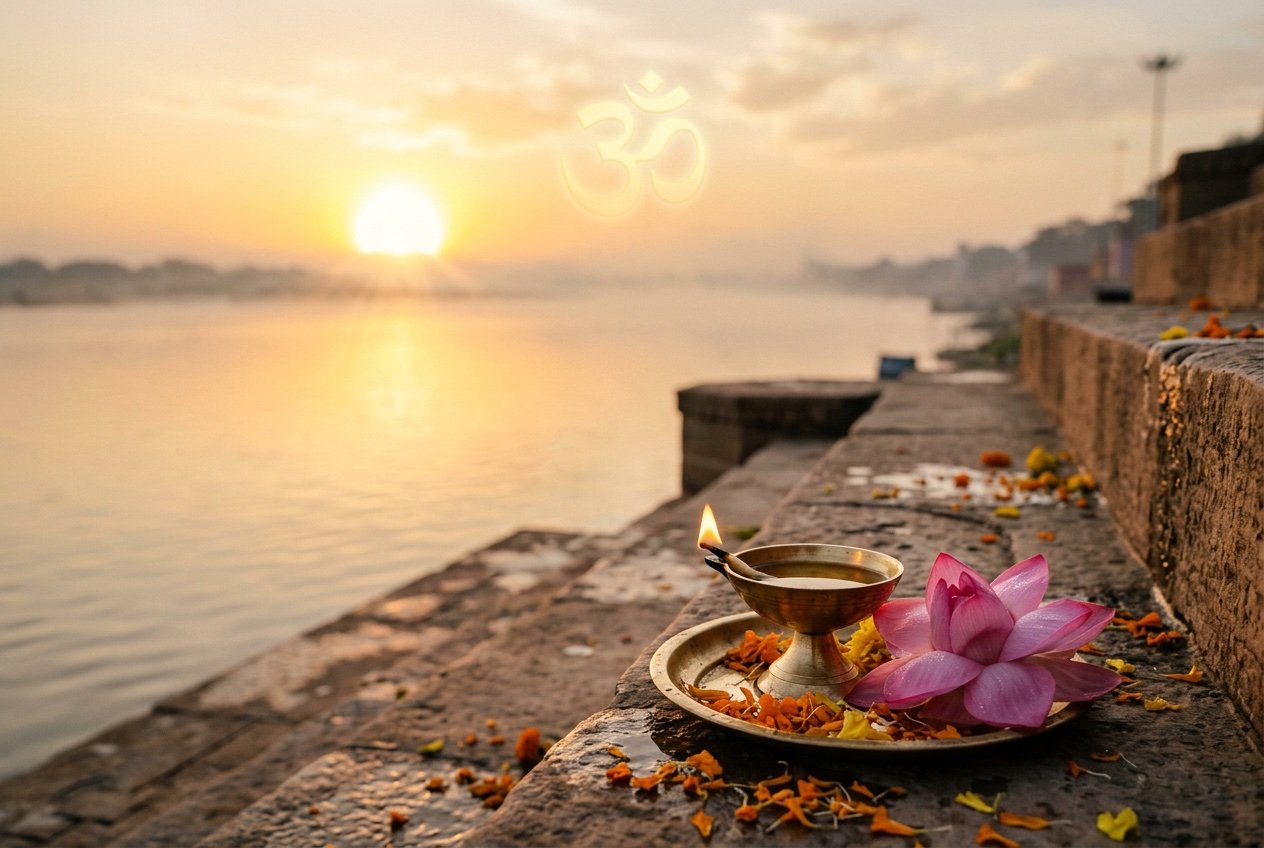
    Few prayers in the world have been recited as continuously, or by as many people, as the Gayatri Mantra. For more than three thousand years it has been chanted at sunrise on riverbanks, whispered in homes before the day begins, and offered into the sacred fire of countless havans. Yet for all its fame, many of us chant it without fully knowing what we are saying. This article is an invitation to slow down and understand the mantra – its words, its origins and its purpose – so that every repetition becomes more meaningful.

    The mantra

    ॐ भूर्भुवः स्वः
    तत्सवितुर्वरेण्यं भर्गो देवस्य धीमहि
    धियो यो नः प्रचोदयात् ॥

    Om bhūr bhuvaḥ svaḥ
    tat savitur vareṇyaṃ bhargo devasya dhīmahi
    dhiyo yo naḥ pracodayāt

    In simple English, the mantra can be rendered as:

    "We meditate upon the most excellent, radiant light of the divine Creator, who pervades the earth, the space between and the heavens. May that light inspire and awaken our intellect."

    What each word means

    The beauty of the Gayatri Mantra lies in how much meaning is held in so few words. Understanding them, even roughly, changes the way the mantra feels when you chant it.

    Om is the primordial sound, the vibration from which, according to the Vedic tradition, all creation emerges. Almost every Vedic prayer begins with it, because it turns the mind towards the infinite before anything else is said.

    Bhūḥ, bhuvaḥ, svaḥ are known as the three vyāhṛtis. They name the three worlds – the earth (bhūḥ), the space or atmosphere (bhuvaḥ) and the heavens (svaḥ). They are also understood as three levels of our own existence: the physical body, the mind and life-energy, and the spiritual self. By saying them, we acknowledge that the divine is present at every level, from the ground beneath our feet to the deepest part of our being.

    Tat means "that" – the Supreme, which is beyond description and can only be pointed to.

    Savituḥ means "of Savitṛ", the divine power that brings everything into being and sets it in motion. Savitṛ is often associated with the sun, not merely as a ball of fire in the sky, but as the source of light, warmth and life itself.

    Vareṇyam means "most excellent" or "worthy of being chosen and adored".

    Bhargaḥ is the radiance or purifying light – the brilliance that burns away ignorance just as the morning sun dissolves darkness.

    Devasya means "of the divine".

    Dhīmahi means "we meditate upon". Notice that it is in the plural – we meditate, not I. The Gayatri Mantra is never a selfish prayer; it is offered on behalf of everyone.

    Dhiyaḥ means "intellects" or understanding; yaḥ means "who"; naḥ means "our"; and pracodayāt means "may he inspire, awaken or guide".

    Put together, the request at the heart of the mantra is remarkable. It does not ask for wealth, success or even freedom from suffering. It asks for one thing only: that our intellect – the faculty with which we judge, choose and act – may be illuminated by the divine light. The tradition holds that when the intellect is pure and awake, everything else in life follows rightly.

    Where the mantra comes from

    The Gayatri Mantra appears in the Rig Veda, the oldest of the four Vedas, in the third mandala (book), hymn 62, verse 10. It is attributed to the great Rishi Vishvamitra, whose life itself is a story of transformation – from a powerful king to a sage of the highest realisation.

    The verse is composed in the gāyatrī metre, a poetic metre of twenty-four syllables arranged in three lines of eight. Over time, the mantra became so closely identified with its metre that it simply came to be called "the Gayatri". The opening Om bhūr bhuvaḥ svaḥ was added in later Vedic practice and is now recited as an inseparable part of it.

    In time, the power of the mantra was personified as Maa Gayatri, the divine mother of wisdom. She is revered as Vedamata, the mother of the Vedas, because the essence of all Vedic knowledge is said to be contained in this single prayer. She is often depicted, as she is at our Dham, seated on a lotus, radiant like the rising sun, accompanied by a swan – the symbol of discernment between the true and the false.

    Why the mantra is so revered

    Across the centuries, saints and scholars have described the Gayatri Mantra as the most universal of prayers. Its appeal lies partly in its simplicity: it does not belong to any one deity, sect or ritual. It is a prayer for light, and light is something every human being needs.

    For much of history, however, the mantra was surrounded by restrictions about who was allowed to recite it. In the twentieth century, Pandit Shriram Sharma Acharya (1911–1990), together with Mata Bhagwati Devi Sharma, dedicated their lives to bringing the Gayatri Mantra and its practice to every home, irrespective of caste, gender or background. Through the Gayatri Pariwar movement they founded, millions of people were introduced to daily Gayatri sadhana, yajna and a life of service. Their message was simple and powerful: the light of Gayatri belongs to everyone. It is this inclusive spirit that inspires the work of Maa Bageshwari Gayatri Dham today.

    What people experience through regular chanting

    The scriptures and the experience of countless practitioners describe the Gayatri Mantra as a prayer that gradually purifies the mind. People who chant it regularly often speak of greater calmness, clearer thinking and steadier concentration. Many find that the quiet minutes spent in japa each morning set the tone for the rest of the day, making it easier to remain patient, kind and focused.

    The rhythm of the mantra itself – twenty-four measured syllables, repeated slowly with the breath – naturally settles a restless mind. And because the prayer asks for a good intellect rather than for personal gain, it slowly turns our attention away from our worries and towards higher values: truth, wisdom and the welfare of others.

    These are spiritual and personal experiences rather than promises, and they deepen with time. Like a lamp that is lit every day, the mantra's light grows steadier the more faithfully it is tended.

    How to chant the Gayatri Mantra

    There is no need for elaborate preparation to begin. What matters most is sincerity and regularity. The following guidance, drawn from long tradition, can help you start.

    Choose your time. The most auspicious time is early morning, before or around sunrise, when the mind is fresh and the surroundings are quiet. Traditionally the mantra is also chanted at noon and at sunset – the three sandhyas, or meeting points of the day. If mornings are difficult, any fixed time that you can keep every day is good.

    Prepare yourself and your space. Bathe or at least wash your hands, face and feet. Sit in a clean, quiet place, ideally facing east, on a mat or folded cloth. Keep your back straight and your body relaxed. Many people like to light a small diya or incense, which helps create a sense of sacred space.

    Settle the mind. Before you begin, take a few slow, deep breaths. Let go of the day's tasks for a few minutes. Remind yourself why you are sitting: to receive light and to become a better person.

    Chant with attention. Recite the mantra slowly and clearly, giving each syllable its full sound. You may chant aloud, in a soft whisper (upāṃśu), or silently in the mind (mānasika); the silent form is considered the most subtle and powerful once concentration grows. A mala of 108 beads helps you keep count without distraction – one bead for each repetition. Beginners can start with one mala a day and gradually increase as the practice becomes natural.

    Meditate on the meaning. While chanting, many practitioners visualise the rising sun – golden, peaceful and full of life – and imagine its light entering the mind and filling it with clarity. Others hold the meaning of the words in their heart. Either way, the aim is to let the mantra be more than sound.

    Close with gratitude. After the japa, sit quietly for a minute or two. Offer a short prayer for the well-being of your family, your community and the whole world, and carry that peaceful feeling into your day.

    A note on pronunciation. Do not worry if your pronunciation is not perfect at first. Listen to a clear recitation, chant along slowly, and it will improve naturally. Sincerity matters more than perfection.

    Chanting together at the Dham

    The Gayatri Mantra is powerful when chanted alone, and many feel it becomes even more so when chanted together. At Maa Bageshwari Gayatri Dham, devotees gather for collective chanting, satsang and our monthly Gayatri Havan, where the mantra is offered with ahutis into the sacred fire for the well-being of all. Everyone is welcome, whether you have chanted for decades or are hearing the mantra for the first time.

    May the radiant light of Maa Gayatri awaken the intellect of all beings, and may it guide us all towards truth, wisdom and peace.

    ॐ शान्तिः शान्तिः शान्तिः

  • Bringing Daily Sadhana into Your Life

    Bringing Daily Sadhana into Your Life

    Most of us live with a quiet sense that something is missing. The days are full – work, studies, family duties, phones that never stop – and yet at the end of it we often feel scattered rather than fulfilled. The sages of India offered a simple answer to this restlessness, one that is just as relevant today as it was thousands of years ago: sadhana, a daily spiritual practice. This article explains what sadhana really means, why it matters, and how you can bring it into even the busiest life, one small and steady step at a time.

    What is sadhana?

    The word sadhana comes from the Sanskrit root sādh, meaning "to accomplish" or "to bring to completion". Sadhana is the effort through which we accomplish the most important work of life: becoming the best version of ourselves, inwardly and outwardly. It is not a single ritual but a way of living with awareness – a regular, sincere discipline that slowly purifies the mind and strengthens character.

    Many people imagine that spiritual practice belongs only to monks in the Himalayas or to elderly people with time on their hands. The tradition says otherwise. The householder – the person with a job, a family and responsibilities – has always been considered capable of deep sadhana. In fact, the challenges of ordinary life are the very field in which our practice is tested and grows. Sadhana does not ask us to run away from the world; it asks us to live in it with a clearer mind and a kinder heart.

    Upasana, Sadhana and Aradhana

    In the Gayatri tradition taught by Pandit Shriram Sharma Acharya, spiritual life is often described through three connected words: Upasana, Sadhana and Aradhana. Understanding them helps us see that practice is much more than sitting with a mala.

    Upasana means "sitting near" the divine. It is the time we set aside each day for prayer, japa, meditation or worship – the moments when we consciously turn towards God and fill ourselves with that light and strength. It is like a plant turning towards the sun.

    Sadhana, in this sense, is the discipline of the self. It is the work of refining our thoughts, habits and conduct: controlling anger, giving up laziness, speaking truthfully, eating and sleeping with moderation, and using our time well. Upasana gives us energy; sadhana uses that energy to reshape our character, just as a sculptor patiently chisels a stone.

    Aradhana is worship through service. It is the expression of our inner growth in the form of love and help for others – caring for family, supporting those in need, protecting nature and contributing to society. The tradition teaches that serving God's creation is itself a form of worshipping God.

    When these three are practised together, spiritual life becomes balanced. Prayer without self-improvement can become empty routine; self-improvement without prayer can become dry and tiring; and both without service can become self-centred. Together, they turn an ordinary life into a sacred one.

    Why a daily practice matters

    The mind is shaped by what we repeat. Every day we repeat certain thoughts, worries and habits, often without noticing, and over the years they become who we are. Daily sadhana is a way of consciously choosing what we repeat. A few minutes of prayer and reflection every morning is like watering a seed: one day's watering seems to make no difference, but over weeks and months something real begins to grow.

    People who keep a regular practice often notice that they react less quickly in anger, recover more easily from disappointment, think more clearly when decisions are hard, and feel a quiet contentment that does not depend on circumstances. These changes do not come from a single dramatic experience. They come from regularity – from showing up every day, even when the practice feels ordinary. This is why the scriptures place so much emphasis on niyam, steady discipline, rather than on occasional intensity.

    A simple morning practice

    You do not need a large shrine, special equipment or hours of free time. What you need is a fixed time, a quiet corner and a sincere heart. The following routine takes about fifteen minutes and can be adjusted to suit your day.

    Begin by waking a little earlier than usual, ideally before sunrise, when the atmosphere is calm and the mind is fresh. Wash your face, hands and feet, or bathe if you can, and sit in the same clean place every day. Over time, that spot itself will begin to feel peaceful. Light a small diya or incense if you wish, and sit comfortably with your back straight, facing east if possible.

    Take the first few minutes simply to settle. Close your eyes and breathe slowly and deeply. Many practitioners do a short pranayama – breathing in gently and fully, holding for a moment, and breathing out slowly – to calm the body and gather the mind. Then offer a short prayer of gratitude for the gift of a new day.

    Next comes japa, the heart of the practice. Chant the Gayatri Mantra slowly and attentively, using a mala of 108 beads to keep count. One mala takes around eight to ten minutes. As you chant, imagine the gentle golden light of the rising sun entering your mind and filling it with clarity, peace and goodness. If your thoughts wander – and they will – simply notice it without frustration and bring your attention back to the mantra. This patient returning is itself the training of the mind.

    After the japa, sit in silence for a minute or two. Then spend a moment planning the day ahead with intention: what is most important today, what kind of person do you want to be in your work and relationships, and is there one good deed you can do? End by offering your practice for the well-being of all, and carry its calm into your day.

    The evening reflection

    If the morning practice fills the lamp with oil, the evening reflection checks that the flame is steady. Before going to sleep, take five minutes to look back over your day honestly but gently. Where did you act well? Where did you lose patience, waste time or speak harshly? Pandit Shriram Sharma Acharya called this ātma-samīkṣā, self-review, and considered it one of the most powerful tools for growth.

    The point is not to judge yourself but to learn. Acknowledge your mistakes, resolve to do a little better tomorrow, and let go. End the day with a few repetitions of the Gayatri Mantra and a prayer of thanks. Many people find that this simple habit brings deeper, more restful sleep and a fresher start the next morning.

    Keeping the practice going

    Starting a practice is easy; keeping it going is where the real sadhana lies. A few lessons from long experience can help.

    Start small and be regular. Ten sincere minutes every day are worth far more than two hours once a month. When the practice is small, it is easy to keep, and once it becomes a habit it naturally deepens on its own.

    Tie your practice to something you already do, such as right after your morning bath or before your morning tea. Habits attach easily to existing routines.

    Be gentle with yourself on difficult days. There will be mornings when you oversleep, are unwell or are travelling. On such days, even a few repetitions of the mantra in your mind, or a moment of prayer on the way to work, keeps the thread unbroken. Never let one missed day become an excuse to give up.

    Keep good company. Spending time with people who value spiritual life – through satsang, collective chanting or reading good books together – keeps our enthusiasm alive. Reading a few pages of uplifting literature each day, known as svādhyāya, is itself considered an essential part of sadhana.

    Sadhana for students and families

    Students often feel they have no time for spiritual practice, yet they may benefit from it the most. Even a short daily japa before study improves concentration, reduces exam anxiety and builds the self-discipline that success requires. Good habits formed in youth – rising early, regular study, respect for parents and teachers, and moderation in the use of phones and screens – become the foundation of a strong and confident life.

    For families, a shared practice can become a beautiful anchor. Gathering for a few minutes each morning or evening to light a lamp, chant the Gayatri Mantra together and share one good thought creates a warmth that no gadget can replace. Children learn far more from what they see their parents do than from what they are told, and a home where prayer and kindness are part of daily life naturally passes these values on.

    Common questions

    People who are starting out often ask whether they need formal initiation to begin. The Gayatri tradition teaches that the mantra is open to everyone, and you can begin today with sincerity; initiation and guidance can deepen the practice later. Others ask what to do if they cannot sit cross-legged. Sitting comfortably on a chair with the back straight is perfectly fine – comfort helps concentration. Many worry that their mind wanders constantly during japa. This is completely normal, and every time you bring your attention back, the mind becomes a little stronger. And if you cannot manage mornings, choose any fixed time you can keep; regularity matters more than the hour.

    Practising together at the Dham

    Sadhana is a personal journey, but it is not one we have to walk alone. At Maa Bageshwari Gayatri Dham, we hold regular satsang, collective Gayatri chanting, our monthly Gayatri Havan, sadhana camps and youth workshops to support everyone who wishes to begin or deepen their practice. Whether you are taking your first step or have been practising for years, you are warmly welcome to join us, ask questions and practise in the company of others on the same path.

    Begin with just a few minutes tomorrow morning. Light a lamp, chant the Gayatri Mantra with love, and offer your day to the divine. Over time, you may find that this small daily practice quietly transforms your whole life.

    ॐ शान्तिः शान्तिः शान्तिः